
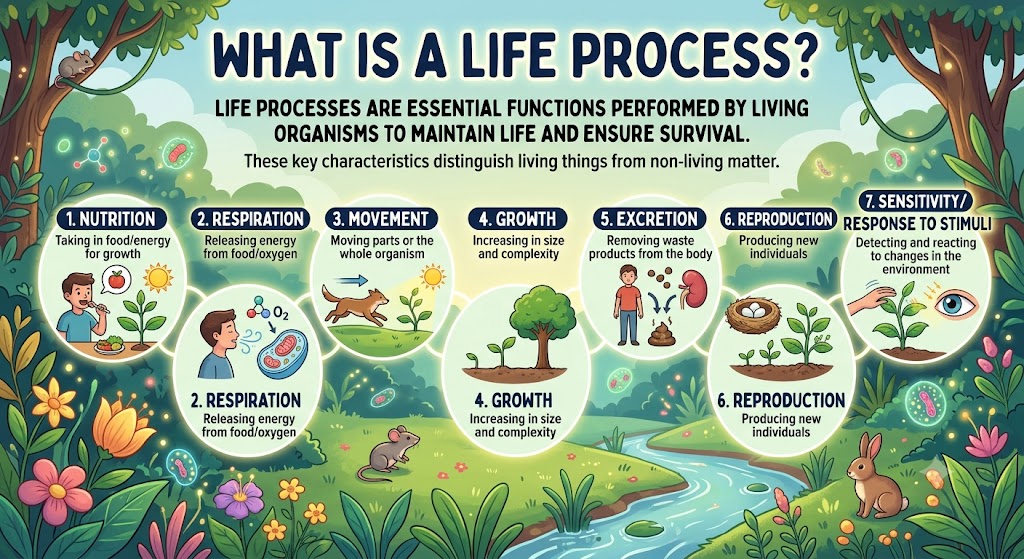

Living organisms carry out numerous activities to survive and operate effectively. These activities go on throughout their lives. Each process contributes to the preservation of life in a certain way. Such processes play a crucial role in the survival of plants, animals and humans in their day to day lives. In their absence, survival and growth would not have been possible.
These biological activities could be well explained by understanding what is life process. It is very useful for learning the basics of biology. This information assists us to understand how living things support life on a daily basis.
Table of Contents
What Is a Life Process?
Knowing what is life process assists in explaining how living creatures execute the necessary biological functions. Such processes operate together to promote survival and good functioning. All living organisms carry them out in their lives. They assist in energy production, sustain growth and eliminate unhealthy waste.
These activities are effectively coordinated by different body systems and organs. Organisms would not be able to survive, develop, and react appropriately to environmental changes without processes.
Why Are Life Processes Important?
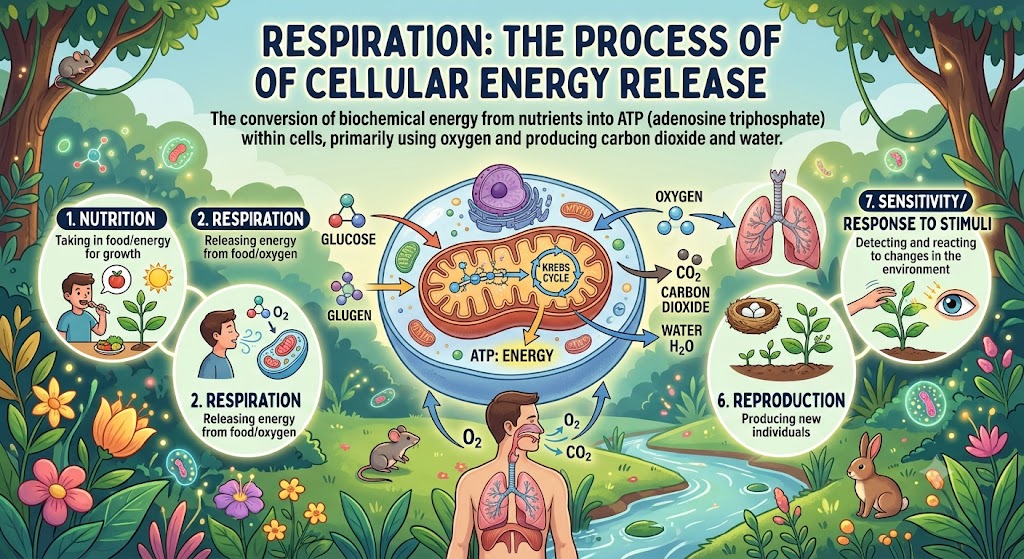
Life processes maintain all living organisms active and healthy. They help in the growth, repairing, and normal body functioning on a daily basis. Such activities are useful in keeping the body in balance. They enable organisms to adjust to the changing environments. In their absence, no survival could be achieved.
Knowing about what is life process helps in explaining the functioning of living organisms in an efficient way. It develops a good knowledge of fundamental biological ideas. Students and anyone who is interested in biology will find this knowledge important.
Major Life Processes
Life involves a number of key processes that collaborate to sustain life. Every process has a particular activity as well as promotes overall physical health.
#1: Nutrition

Nutrition supplies energy to survive and facilitate daily body activities. It promotes growth, tissue healing and general health. Plants feed using photosynthesis, and animals feed using other organisms.
#2: Respiration
The process of food energy release is referred to as respiration. Glucose is broken down using oxygen to release energy required for body functions. This energy supports mobility, development, and other vital biological functions.
#3: Transportation
Transportation entails the movement of nutrients, oxygen, hormones and waste products throughout the body. This is an important role played by the circulatory system in humans. Plants have specialized tissues that carry water and nutrients to various parts.
#4: Excretion
Excretion is the elimination of unhealthy waste products that are created in the course of metabolic processes. Kidneys, lungs and skin are organs that support the excretion of human body waste. This procedure ensures inner balance and safeguards overall health.
Other Essential Life Processes
In addition to the key life processes, living organisms also carry out other activities that they need to survive.
#1: Growth
For all living beings, growth is a continuous process. It enhances body size and promotes good development. The damaged cells are replaced by new ones as well as assisting tissues and organs to perform effectively.
#2: Reproduction
The continuation of any living species is guaranteed by reproduction. It enables organisms to produce offspring with similar traits. This process promotes sustainable biodiversity and survival of future generations.
#3: Response to Stimuli
Living things are always responsive to environmental changes. Such variations can be light, temperature, sound or touch. Rapid reactions help organisms to protect them and adjust to various environmental changes.
Examples of Life Processes
Simple everyday examples can help to understand what is life process. Human beings breathe in and out to gain oxygen for producing energy. This process supports all organs and body functions. Plants use sunlight, water and carbon dioxide to prepare the food. Animals eat food to get the necessary nutrients and energy.
The circulatory system carries oxygen and nutrients throughout the body. Kidneys eliminate wastes to ensure internal balance. A combination of these activities helps the living organisms to survive, develop, and perform effectively.
Conclusion
The survival and growth of any living organism is based on life processes. These are nutrition, respiration, transportation, excretion, growth, reproduction and responses to environmental changes. All processes are important for sustaining life and proper body functioning.
Understanding what is life process enables us to know how the body systems interact with each other. With this knowledge, it is easier to find out how various living organisms operate and survive.
For more information, visit here.
